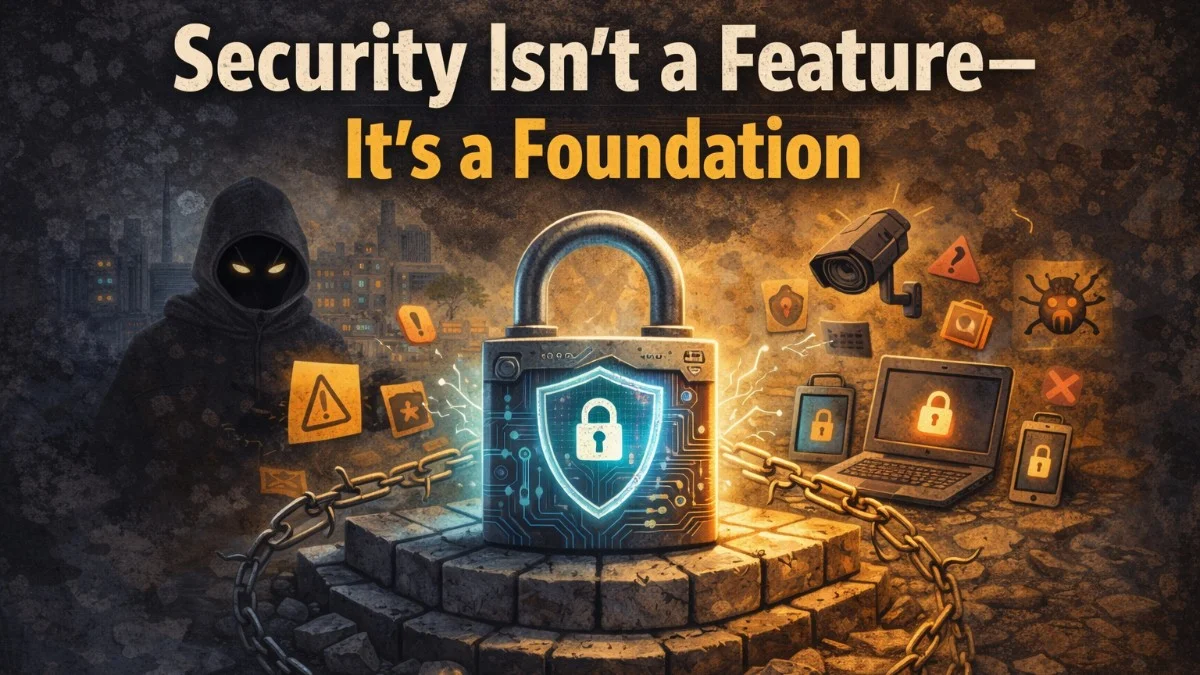
"We'll add security before launch."
I've heard this from at least a dozen clients before they became our clients.
It never works.
Security isn't something you add. It's something you build on.
What happens when you bolt security on at the end:
→ The login system stores passwords in plain text. Fixing it requires restructuring the entire auth flow. → API endpoints have no authorization. Every route needs to be audited and locked down. → User input goes straight to the database. SQL injection vulnerabilities everywhere. → File uploads accept anything. Someone uploads a PHP file and suddenly owns your server. → Session management is an afterthought. Users can hijack each other's sessions.
Each of these is a full rewrite of the affected system. Not a quick fix. Not a patch. A rewrite.
The cost comparison:
Building security in from the start: 10-15% of development time. Retrofitting security after the fact: 40-60% of a rebuild. Plus the breach risk while you're fixing it.
What 'security from day one' actually means:
Authentication: → Passwords hashed with bcrypt or Argon2 (never MD5, never plain text) → Multi-factor authentication available from launch → Rate limiting on login attempts → Secure session management with proper expiration
Authorization: → Every route checks permissions → Role-based access control designed before the first feature → API endpoints require authentication by default → Admin functions are isolated and audited
Data protection: → Input validation on every form and API endpoint → Parameterized queries (never string concatenation) → Output encoding to prevent XSS → File upload validation (type, size, content) → Sensitive data encrypted at rest
Infrastructure: → HTTPS everywhere (no exceptions) → Security headers configured (CSP, HSTS, X-Frame-Options) → Dependencies monitored for known vulnerabilities → Automated security scanning in CI/CD → Regular dependency updates
The question to ask your developer:
"Walk me through how you handle authentication, authorization, and input validation."
If the answer is vague, they're planning to bolt it on later.
We build security into the foundation of every project. Not because we're paranoid—because it's the only responsible way to build software.
→ scopeforged.com
Philip Rehberger Founder, ScopeForged scopeforged.com
#Security #SoftwareDevelopment #CyberSecurity #BestPractices