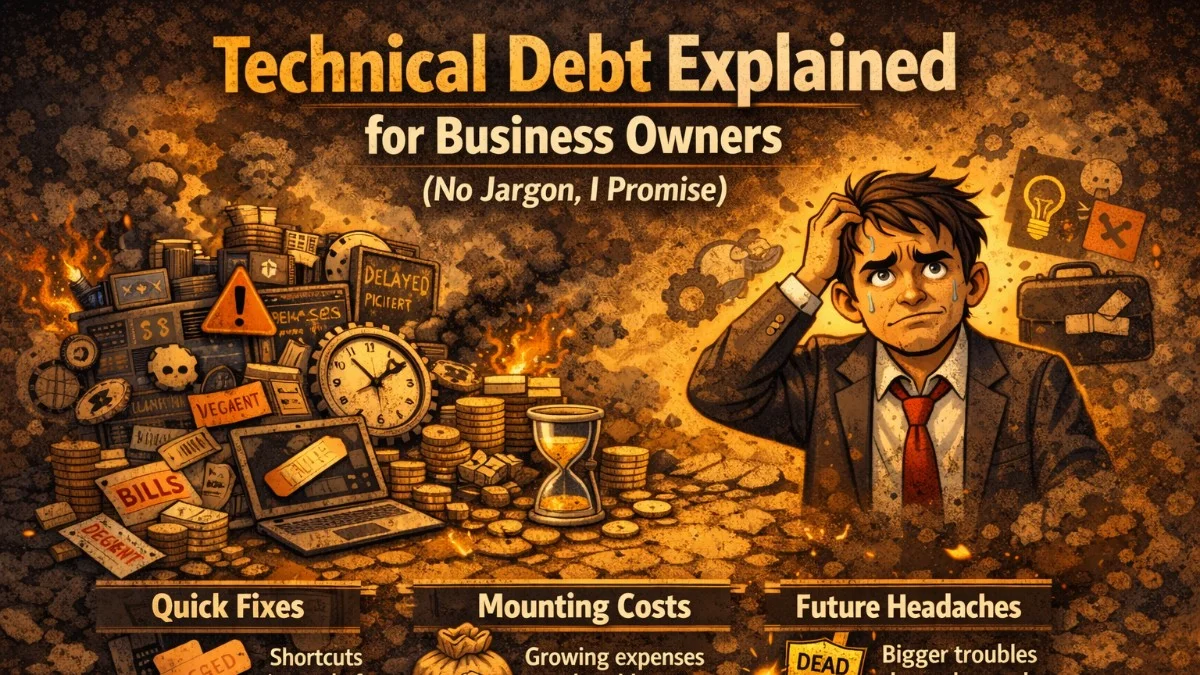
Your developer says you have "technical debt."
You nod. You have no idea what that means.
You're not alone. Let me explain it without the jargon.
Technical debt is a loan you took out against your future self.
Sometime in the past, a decision was made to do something the fast way instead of the right way. Maybe to hit a deadline. Maybe to save money. Maybe nobody knew better.
That shortcut worked. The feature shipped. Everyone was happy.
But like any loan, it accrues interest.
Here's what the "interest" looks like:
→ Features that used to take 2 days now take 2 weeks → Every change breaks something else → Your developers spend more time fixing old problems than building new things → New developers take months to become productive because the code is tangled → Security vulnerabilities hide in code nobody wants to touch
The business cost:
Imagine you're paying a developer $150/hour.
If technical debt means every feature takes 3x longer than it should, you're effectively burning $300/hour for $150/hour of output.
That's the interest payment. And it compounds.
How it accumulates:
→ "We'll clean it up after launch" (you won't) → "Just make it work for now" (it'll work badly forever) → "We don't have time for tests" (you'll spend 5x more time debugging) → "The next developer can fix it" (they'll add more debt instead)
What to do about it:
- Acknowledge it exists. Ask your developer to quantify it. Where is the debt? What's the impact?
- Budget for it. Allocate 15-20% of development time to paying down debt.
- Stop adding more. Insist on quality standards for new work, even if it's slightly slower.
- Get an independent audit. Sometimes you need an outside perspective to see the full picture.
The bottom line:
Technical debt isn't a failure. Every codebase has some.
But ignoring it is like making minimum payments on a credit card. Eventually, the interest consumes everything.
If you suspect your codebase has significant technical debt and want a clear assessment, we offer code audits that translate technical findings into business impact.
Philip Rehberger Founder, ScopeForged scopeforged.com
#TechnicalDebt #BusinessStrategy #SoftwareDevelopment #CTO