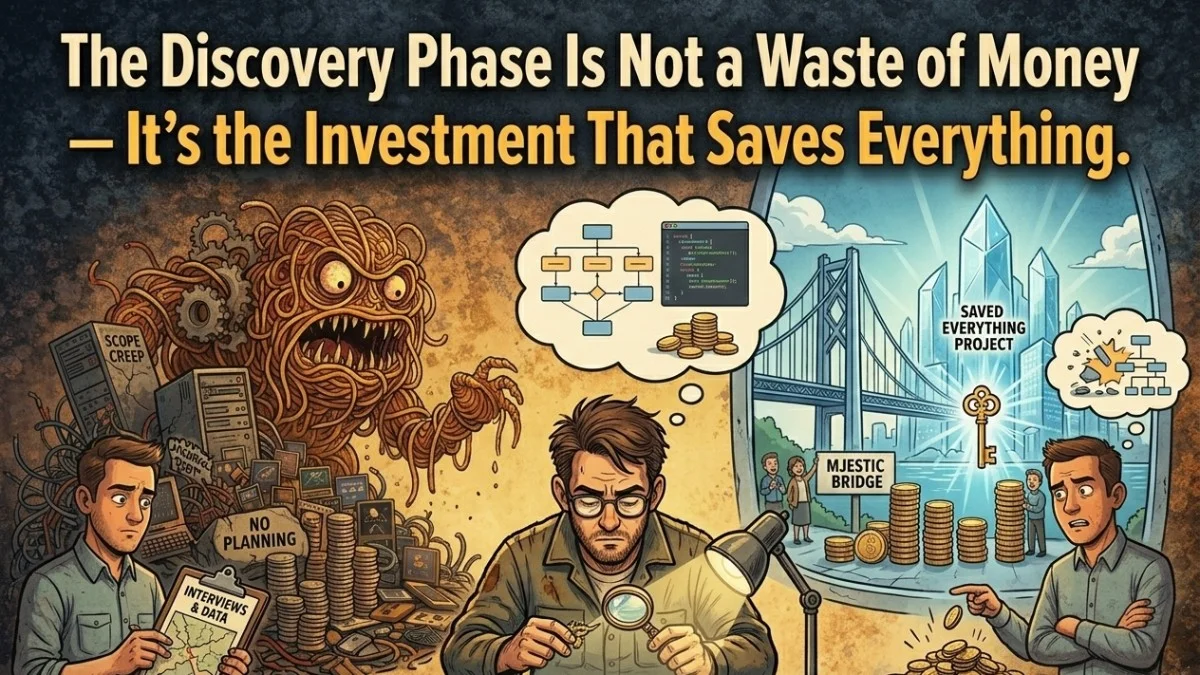
"Can't we just skip discovery and start building?"
I hear this on half of our sales calls.
I get it. Discovery feels like paying for talking instead of doing.
You want to see progress. You want working software. You don't want to spend $5-10K on meetings and documents.
I've never seen skipping discovery go well.
Not once.
What Discovery Actually Catches
Wrong Assumptions
"We thought users would want X" turns into "Users actually need Y" — before you build the wrong thing.
Missing Requirements
"Oh, we also need to integrate with our accounting system" — discovered in week 1, not week 8.
Technical Constraints
"That API doesn't actually support what we need" — found during research, not mid-development.
Integration Surprises
"Their API is deprecated and they're sunsetting it in 6 months" — good to know before you build on it.
Scope Gaps
"We never talked about mobile" or "What about reporting?" — addressed in the plan, not as surprises.
The Real Story
A client came to us wanting to build a scheduling platform.
They wanted to skip discovery. "We know what we need. Let's just build it."
We insisted on a 2-week discovery phase.
Here's what we found:
→ Their current system had data they needed to migrate (8,000 records) → They needed SSO integration with Azure AD (not mentioned in initial brief) → They were about to be audited and needed HIPAA compliance → Their "simple" workflow had 12 edge cases they hadn't thought through → Two of their key integrations didn't actually have APIs
If we'd started building immediately?
We would have built the wrong thing, discovered requirements mid-project, blown the budget, missed the deadline, and frustrated everyone.
Instead, the 2-week discovery:
→ Saved 6 weeks of rework → Identified compliance requirements before they became violations → Found alternative solutions for the missing APIs → Created a realistic timeline and budget → Got stakeholder alignment before code was written
Cost of discovery: $8K
Cost of not doing discovery: $60K+ in rework, delays, and scope creep
What You Get From Discovery
→ Technical architecture document → Detailed requirements and user stories → Risk assessment and mitigation plan → Realistic timeline and budget → Wireframes or prototypes → Stakeholder alignment
You're not paying for talking. You're paying for thinking.
Thinking before building is always cheaper than rework after building.
The Truth
Every project does discovery.
Either you pay for it upfront as a focused phase, or you pay for it in mid-project surprises, scope creep, delays, and rework.
The second option always costs more.
Discovery isn't a waste. It's insurance.
Have you ever skipped discovery and regretted it?
#SoftwareDevelopment #ProjectManagement #ProductDevelopment #Discovery
→ scopeforged.com
Philip Rehberger Founder, ScopeForged scopeforged.com