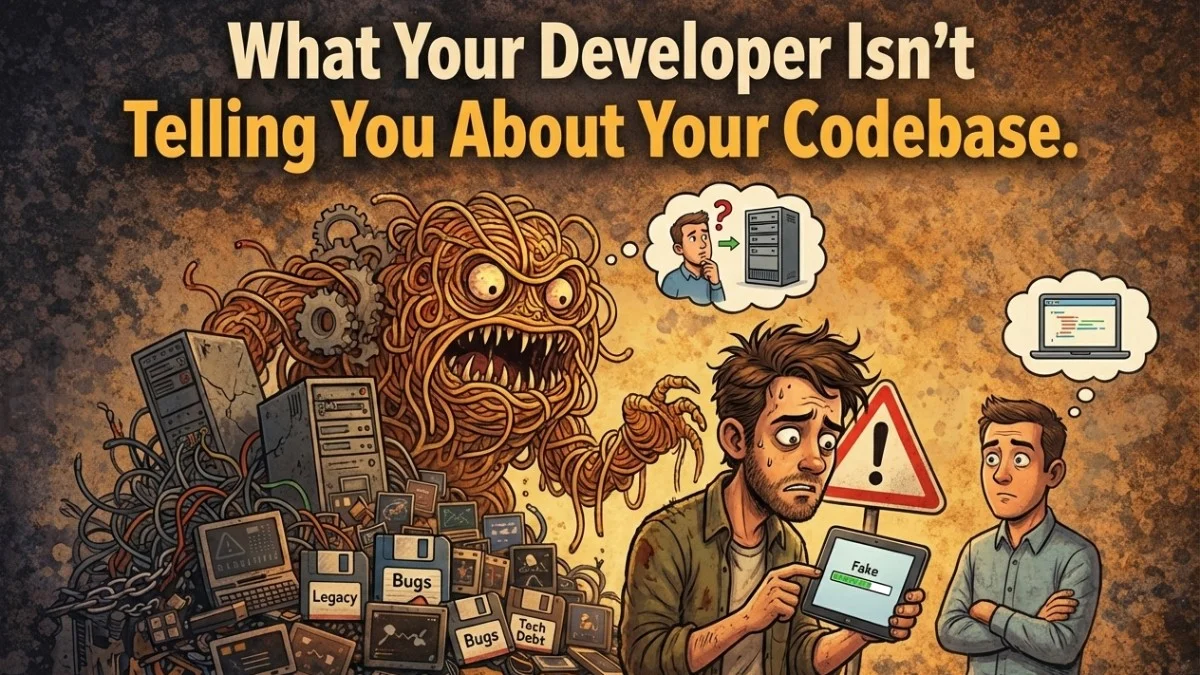
Your application works.
Customers are using it. Revenue is growing. Support tickets are manageable.
Everything seems fine.
But your developer knows things they're not telling you.
Not out of malice. Out of fear. Fear that you'll blame them, panic, or make rushed decisions.
Here's what they're probably not saying:
"The test suite doesn't actually test anything meaningful."
You were told there are tests. There are. They test that true equals true and that the homepage returns a 200 status code.
The business logic? The payment flow? The edge cases that lose customers money? Untested.
"We have security vulnerabilities we haven't fixed."
Dependency scanners have been flagging issues for months. The fixes require updating libraries, which might break things, which requires testing, which takes time nobody has budgeted.
So the warnings sit there. Ignored.
"Parts of the system are held together with duct tape."
That feature you needed urgently last quarter? It was built as a hack because there wasn't time to do it properly. It works, but it's fragile. One wrong change and it breaks in ways nobody expects.
"We're one key person away from a crisis."
One developer understands the payment system. One person knows how deployments work. One engineer built the reporting module and nobody else has ever touched it.
If any of them leaves, you're in trouble.
"Performance is getting worse, not better."
Each new feature adds weight. Database queries that were fast with 1,000 users are slow with 100,000. Nobody is optimizing because new features always win the priority battle.
Why they don't tell you:
→ They don't want to be the bearer of bad news → They're afraid you'll see it as their failure → They hope they'll get time to fix it later (they won't) → They don't know how to explain technical risk to non-technical stakeholders
What to do about it:
Create safety for honesty. Make it clear that surfacing problems is valued, not punished.
Schedule regular technical health checks. Like a physical for your software. Quarterly is ideal.
Get an outside opinion. An independent code audit reveals things internal teams can't or won't say.
Budget for maintenance. 15-20% of your development time should be maintenance, not features.
We do honest codebase assessments. No judgment. Just a clear picture of where you stand and what to prioritize.
→ scopeforged.com
Philip Rehberger Founder, ScopeForged scopeforged.com
#CodeQuality #TechnicalDebt #SoftwareAudit #DeveloperRelationships