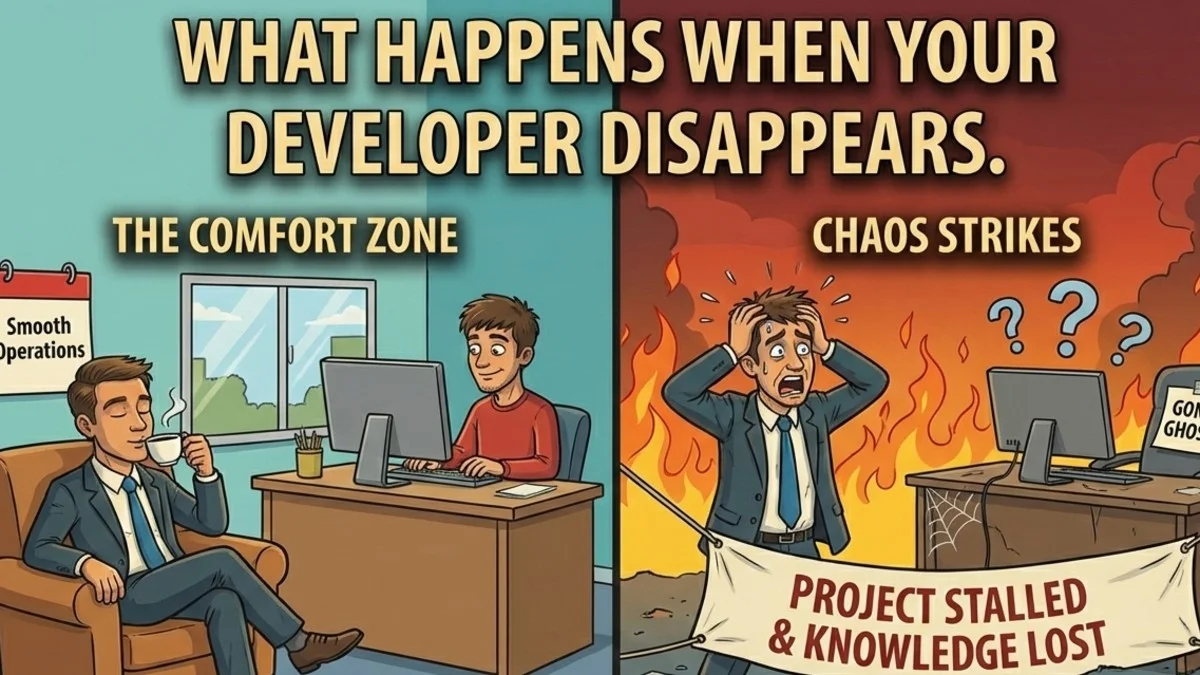
It starts with a slow reply.
Then a missed deadline. Then radio silence.
Your developer has disappeared. And your business is stuck.
This happens more than you'd think.
Freelancers burn out, take on too much work, or simply move on. Agencies lose key staff and can't deliver. Offshore teams dissolve overnight.
And you're left holding an unfinished product with no documentation and no access.
The immediate damage:
→ No code access. If the code lives on their server or their GitHub, you might not have it. → No documentation. Nobody else can pick up where they left off. → No deployment knowledge. The app is running somewhere and you don't know how. → No passwords. Critical accounts are tied to their email. → Wasted investment. Months of development might need to be redone.
How to protect yourself before it happens:
1. Own everything from day one.
The code repository should be in YOUR account. The server should be in YOUR account. Every third-party service should be registered to YOUR business email.
2. Require documentation as a deliverable.
Not at the end. Throughout the project. If your developer can't explain how something works in writing, that's a red flag.
3. Get regular code deliveries.
Don't wait until the project is "done" to see code. Weekly commits to your repository. Working deployments at every milestone.
4. Have a transition plan.
Ask upfront: "If we need to switch developers, what would they need to get started?" If the answer is "just talk to me"—that's the problem.
5. Keep credentials separate.
Use a shared password manager. Never let a contractor be the sole holder of production credentials.
What we do differently:
Every client owns their code, their servers, and their accounts from day one. Our documentation ships with every milestone. If you ever want to leave, you can—with everything you need.
Because your software shouldn't be held hostage.
→ scopeforged.com
Philip Rehberger Founder, ScopeForged scopeforged.com
#SoftwareDevelopment #FreelancerRisk #BusinessProtection #DeveloperRelationships