Your lead developer just put in their two weeks.
They've been with you for three years. They built the entire system. They know where everything is, why every decision was made, and how all the pieces connect.
That knowledge is about to walk out the door.
And none of it is written down.
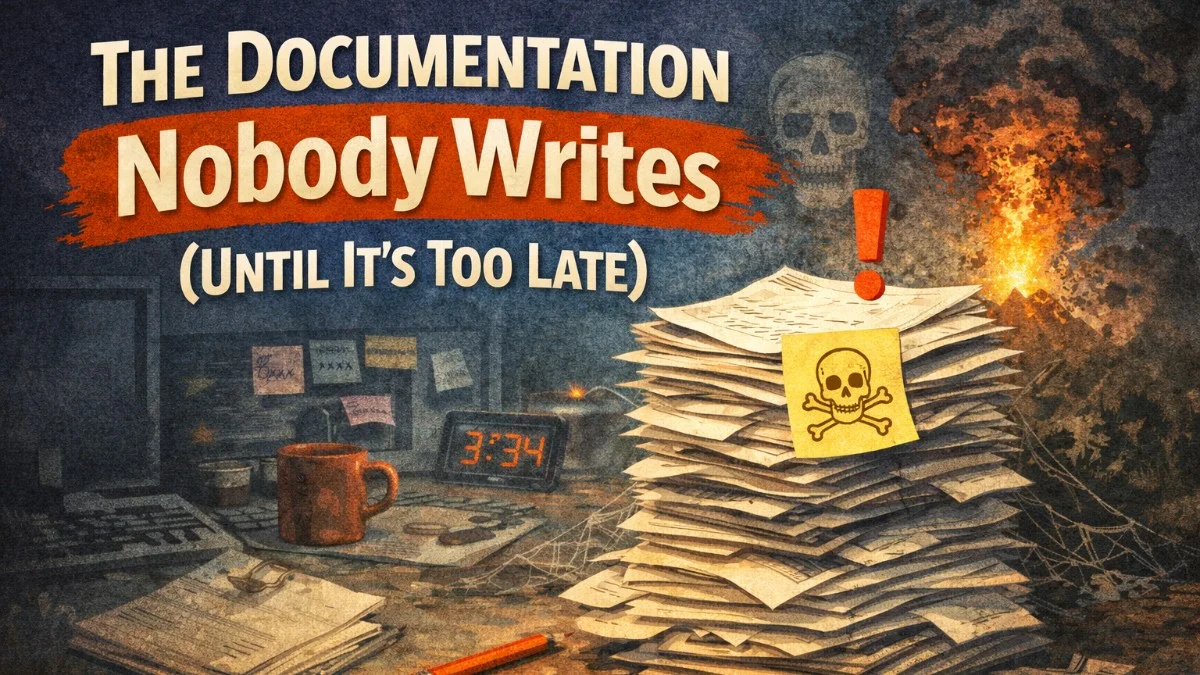
This is the documentation crisis nobody talks about.
Not API docs. Not code comments. The stuff that actually matters:
→ Why the system is architected this way (not just how) → What was tried and abandoned (and why) → Where the workarounds are (and what they're working around) → How to deploy, rollback, and recover from failures → Which parts are fragile and need careful handling → What the monitoring alerts mean and how to respond
The cost of missing documentation:
A new developer joins. Without documentation:
→ Week 1-2: Staring at code trying to understand the structure → Week 3-4: Making small changes, accidentally breaking things → Month 2-3: Finally productive, but still discovering landmines → Month 4-6: Comfortable, but has unknowingly introduced new technical debt
With documentation:
→ Week 1: Reads the architecture guide and deployment docs → Week 2: Makes their first meaningful contribution → Month 1: Fully productive
The difference is months of salary burned on ramping up.
Why documentation doesn't get written:
→ "We'll document it later." (You won't.) → "The code is self-documenting." (It isn't.) → "We're moving too fast." (You're moving fast toward a cliff.) → "Only I work on this, so it doesn't matter." (Until you leave, get sick, or burn out.)
What actually needs to be documented:
Not everything. Just these five things:
- Architecture overview — How the system is structured and why
- Setup guide — How to get the project running from zero
- Deployment process — How to ship code to production
- Decision log — Why major technical choices were made
- Known issues — Where the dragons are
That's it. Five documents. A few hours of writing that saves months of confusion.
Our approach:
Documentation is a deliverable in every engagement. Not optional. Not "if we have time." It ships with the code.
Because code without documentation is a ticking time bomb.
Philip Rehberger Founder, ScopeForged scopeforged.com
#Documentation #SoftwareDevelopment #TechnicalDebt #Engineering