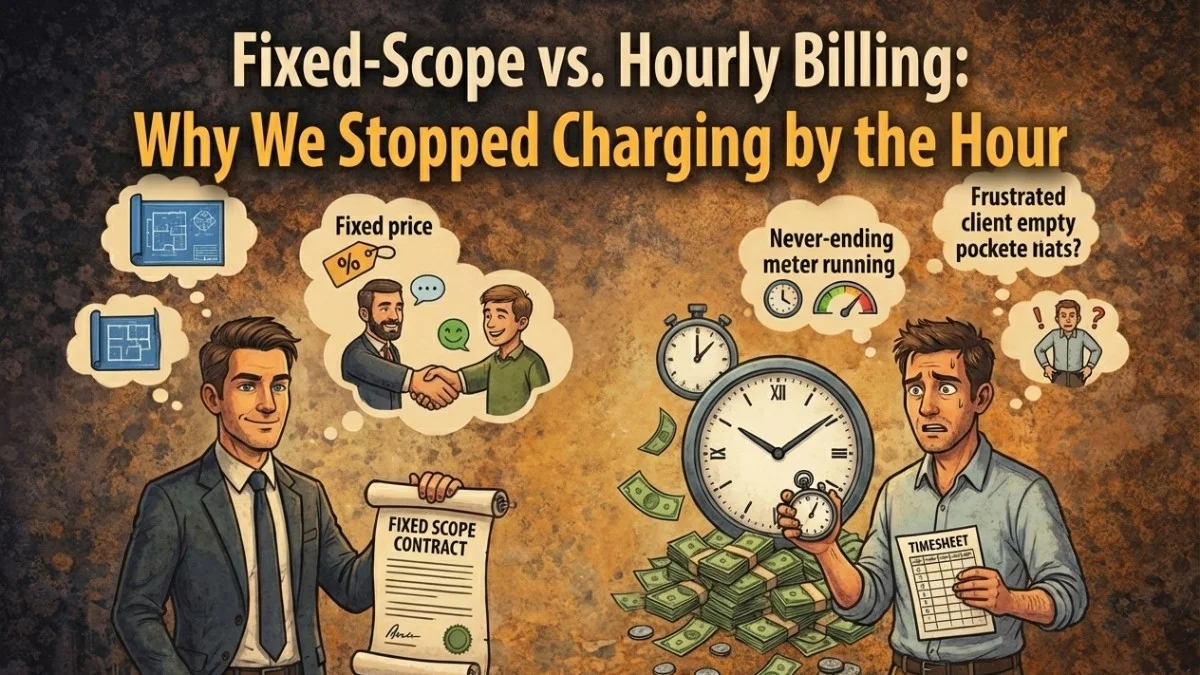
Hourly billing has a dirty secret:
It rewards the wrong behavior.
The slower a developer works, the more they earn. The more confusion in the project, the more billable hours. The more revisions, the bigger the invoice.
As a client, you're paying for time. Not results.
We used to bill hourly. Then we did the math.
What we found:
Our best developers—the ones who solved problems fastest—generated the least revenue.
Our most efficient projects were our least profitable.
The incentives were completely backwards.
So we changed everything.
We moved to fixed-scope milestones. Here's how it works:
→ Discovery phase defines exactly what will be built → Each milestone has a fixed price and clear deliverables → You know the total cost before we write a line of code → We eat the cost if we're slow. You don't.
What this means for clients:
→ No surprise invoices → No anxiety about "is this call billable?" → No incentive for us to drag things out → Complete alignment: we both want the project done well and done efficiently
The objection we always hear:
"But what if scope changes?"
It will. That's why we have a change request process. New scope gets defined, priced, and approved before work starts. You always know what you're paying for.
The result:
Our client satisfaction went up. Our margins improved. And the constant tension around invoicing disappeared.
Fixed-scope isn't just a billing model. It's a trust model.
When your developer's incentives align with yours, better software gets built.
Curious how fixed-scope milestones work in practice? See how we structure engagements at scopeforged.com.
Philip Rehberger Founder, ScopeForged
#Pricing #SoftwareConsulting #Freelancing #BusinessModel