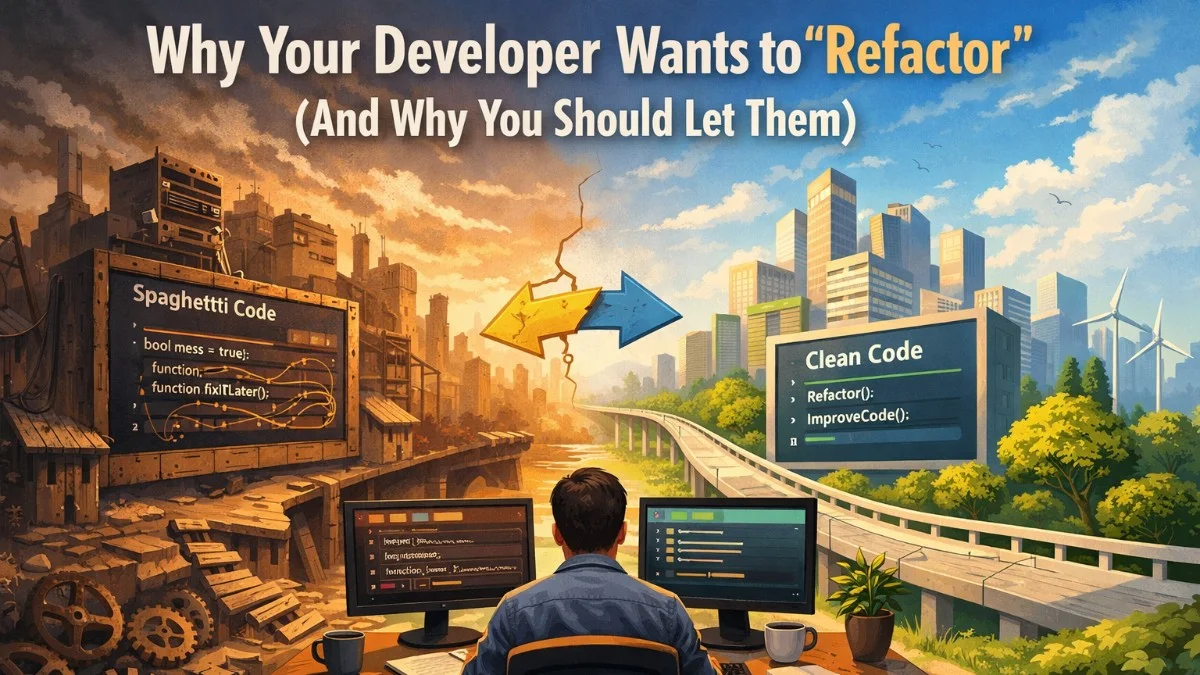
Your developer just asked to spend two days refactoring. No new features. No visible changes. Just reorganizing code.
You're thinking: "Why are we paying for this?"
Here's why you should say yes.
What Refactoring Actually Is
Refactoring = reorganizing code without changing what it does.
Think of it like reorganizing a warehouse. Nothing new comes in. Nothing gets thrown out. But now workers can find things 10x faster.
The products don't change. The system for managing them does.
Same with code. After refactoring, your app does the exact same thing. But the code is cleaner, easier to understand, and faster to modify.
Why Code Gets Messy
When you're building fast, you make tradeoffs.
You write code that works right now, but isn't organized for long-term maintainability. That's fine. Speed matters early.
But if you never clean it up, every new feature takes longer and longer.
I've seen codebases where adding a simple button takes 3 days because the code is so tangled that changing one thing breaks five others.
That's technical debt. And refactoring pays it down.
The Business Case
Here's the math:
→ Spend 2 days refactoring now → Or spend 2 extra weeks on every feature for the next year
Which costs more?
One client resisted refactoring for 8 months. Every new feature was slow and buggy. Finally, we spent 2 weeks refactoring. After that, feature velocity doubled.
They got ROI in 6 weeks.
When to Refactor
Not constantly. But strategically.
Refactor when:
→ You're about to build a major new feature → The same bug keeps appearing in different places → A section of code has been modified 5+ times and is getting messy → Your developer says "I can't add that without refactoring first"
Don't refactor when:
→ You're on a tight deadline → The code works and you're not touching it again soon → You're pre-revenue and need to ship features fast
How ScopeForged Handles This
We build refactoring into our process.
After every major milestone, we do a cleanup pass. It's built into the timeline. You're not surprised by a refactoring request 6 months in.
We also write code cleanly from the start, which reduces the need for heavy refactoring later.
The Bottom Line
If your developer asks to refactor, ask them why and what the impact will be.
Good answer: "This will make the next 3 features 50% faster to build."
Bad answer: "I just want the code to look nicer."
Refactoring should have a business justification. When it does, say yes.
Your future self will thank you.
Have you ever regretted NOT refactoring?
#SoftwareDevelopment #TechnicalDebt #CodeQuality #StartupAdvice #EngineeringLeadership
→ scopeforged.com
Philip Rehberger Founder, ScopeForged scopeforged.com