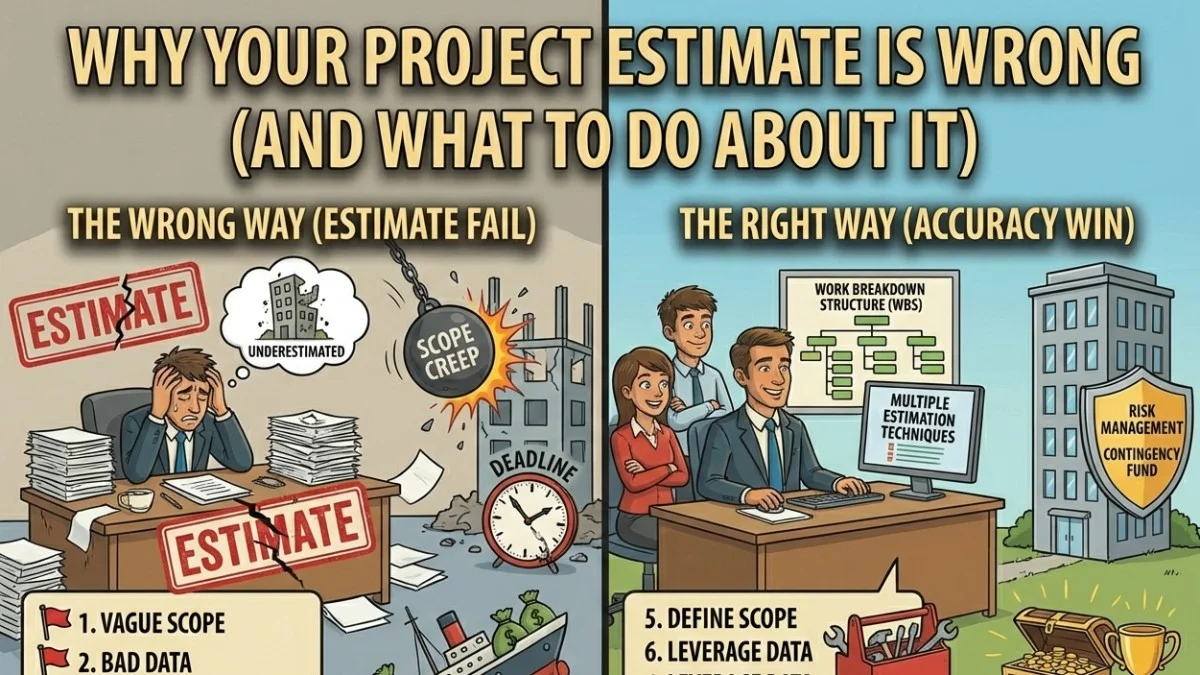
Every software project estimate is wrong.
Not because developers are bad at estimating. Because software development is fundamentally unpredictable.
Here's why estimates fail:
1. You're estimating something that's never been built before.
If it existed already, you'd buy it. You're asking someone to predict the future of a creative process. That's not estimation—that's guessing.
2. Requirements change.
Not because anyone is irresponsible. Because building software reveals things you couldn't have known at the start. The act of building teaches you what you actually need.
3. The easy parts aren't the expensive parts.
That feature that seems simple? It touches authentication, payments, notifications, and three third-party APIs. The complex-sounding feature? It's a straightforward CRUD operation.
4. Integration is where time disappears.
Individual features work fine in isolation. Making them work together is where 40% of development time hides.
What to do instead:
→ Use ranges, not fixed numbers. "4-6 weeks" is honest. "Exactly 4 weeks" is a lie.
→ Break it into phases. Estimate phase 1 in detail. Estimate phases 2-3 roughly. Re-estimate after each phase.
→ Build the riskiest part first. If something is going to blow up the timeline, find out in week 2, not week 12.
→ Budget for discovery. Plan for 15-20% of the timeline being spent on things nobody anticipated.
→ Communicate early when estimates change. The worst thing isn't being wrong—it's being wrong silently.
Our approach:
We give honest ranges. We re-estimate as we learn. And we tell you immediately when something changes.
Because a realistic estimate that adjusts is infinitely more useful than a fantasy number that never moves.
Want an honest assessment of your project? We'll tell you what we know and what we don't.
→ scopeforged.com
Philip Rehberger Founder, ScopeForged scopeforged.com
#SoftwareDevelopment #ProjectManagement #Estimation #Entrepreneurship