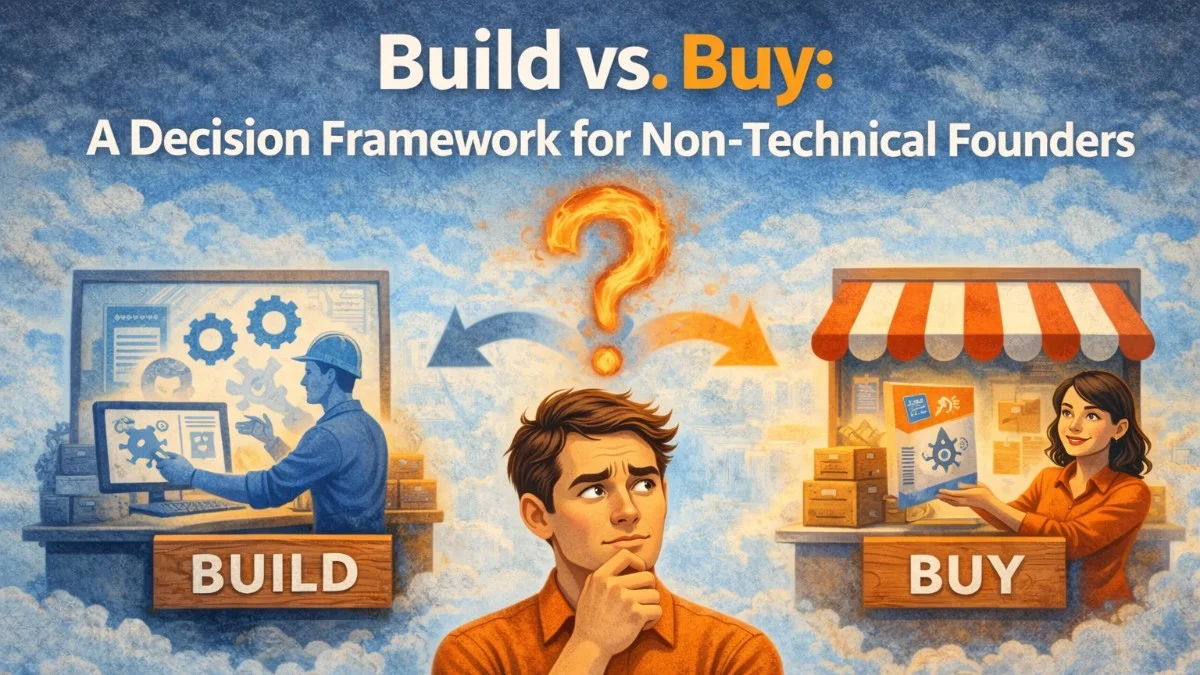
"Should we build this or buy it?"
I hear this question weekly from founders who aren't technical. And the answer is always: it depends.
But here's a simple framework I use:
Build when:
→ It's your core differentiator. If this is what makes you different from competitors, build it. You can't differentiate on someone else's software.
→ Off-the-shelf can't flex to your workflow. If the tool forces you to change how you work (and that change hurts your business), build custom.
→ You need it to scale uniquely. If your growth model is different, standard tools will break at scale.
Buy when:
→ The problem is already solved well. Accounting, email, project management, these are solved problems. Don't rebuild them.
→ Speed matters more than perfect fit. If you need to test an idea fast, buy first, build later.
→ Maintenance would be a burden. Off-the-shelf tools get updates, security patches, and new features. Custom software requires ongoing investment.
Hybrid when:
→ 70% exists but 30% needs custom. Use an off-the-shelf core and build integrations or extensions for your unique needs.
The Decision Matrix:
- Is this a competitive advantage? (Yes = Build)
- Does a good solution already exist? (Yes = Buy)
- Will the off-the-shelf tool force bad workflows? (Yes = Build)
- Do we have budget for ongoing maintenance? (No = Buy)
Here's the truth: Most founders over-build and under-buy.
They build custom tools for things that don't matter and buy generic tools for things that do.
The best way to figure it out? A paid project assessment.
At ScopeForged, we charge for discovery because free discovery calls skip the hard analysis. A real assessment maps your business, audits your existing tools, and tells you exactly what to build vs. buy.
What's the hardest build-vs-buy decision you've faced?
#SoftwareDevelopment #StartupStrategy #BuildVsBuy #TechDecisions #ProductStrategy
→ scopeforged.com
Philip Rehberger Founder, ScopeForged scopeforged.com