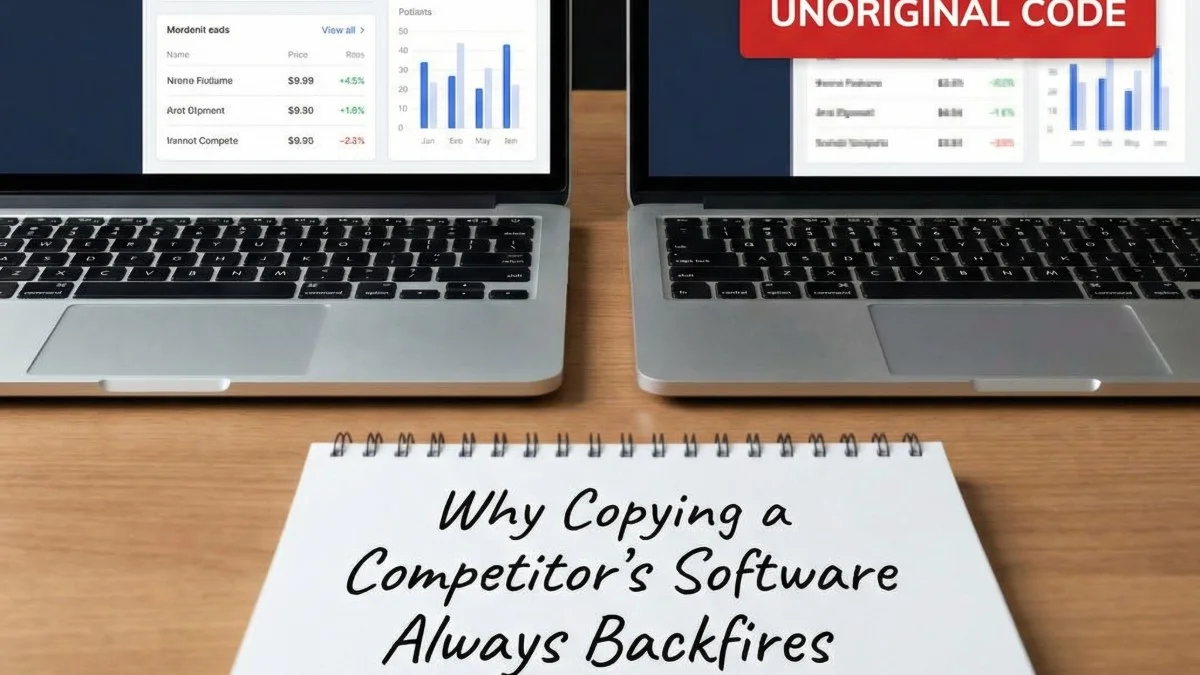
"Just make it look like Notion."
I hear this a lot. A client sees a competitor's slick product and wants the same thing. Makes sense, right?
Except you're seeing their frontend, not their reality.
You're not seeing:
→ The 3 years of iteration that got them there → The 47 features they tried and killed → The user research that informed every decision → The technical debt hiding under the polish → The 10 engineers maintaining it
You're building V1 of what they have at V10.
And it's going to feel like a knockoff. Because it IS a knockoff.
Your users will compare your V1 to their V10 and ask why yours feels half-baked. Because you copied the surface without understanding the depth.
The Better Approach
Understand WHAT problem your competitor is solving. Then solve it YOUR way for YOUR users.
Differentiate, don't duplicate.
Maybe they have a complex feature because their enterprise clients need it. You're targeting small teams. You can be simpler.
Maybe they have a specific workflow because of their tech stack. You're using different tools. You can be faster.
Maybe they made trade-offs years ago that they're stuck with. You're starting fresh. You can be better.
I worked with a CRM client who wanted to clone Salesforce. We asked WHY Salesforce was successful, not HOW it looked.
Turns out: their users hated Salesforce's complexity. They wanted something simpler, faster, focused.
So we built the anti-Salesforce. And it worked.
Your competitive advantage isn't in copying. It's in understanding your users better than anyone else.
What's a competitor feature you almost copied but didn't? What did you build instead?
#ProductStrategy #CompetitiveAnalysis #SoftwareDevelopment #ProductDifferentiation #Innovation
→ scopeforged.com
Philip Rehberger Founder, ScopeForged scopeforged.com