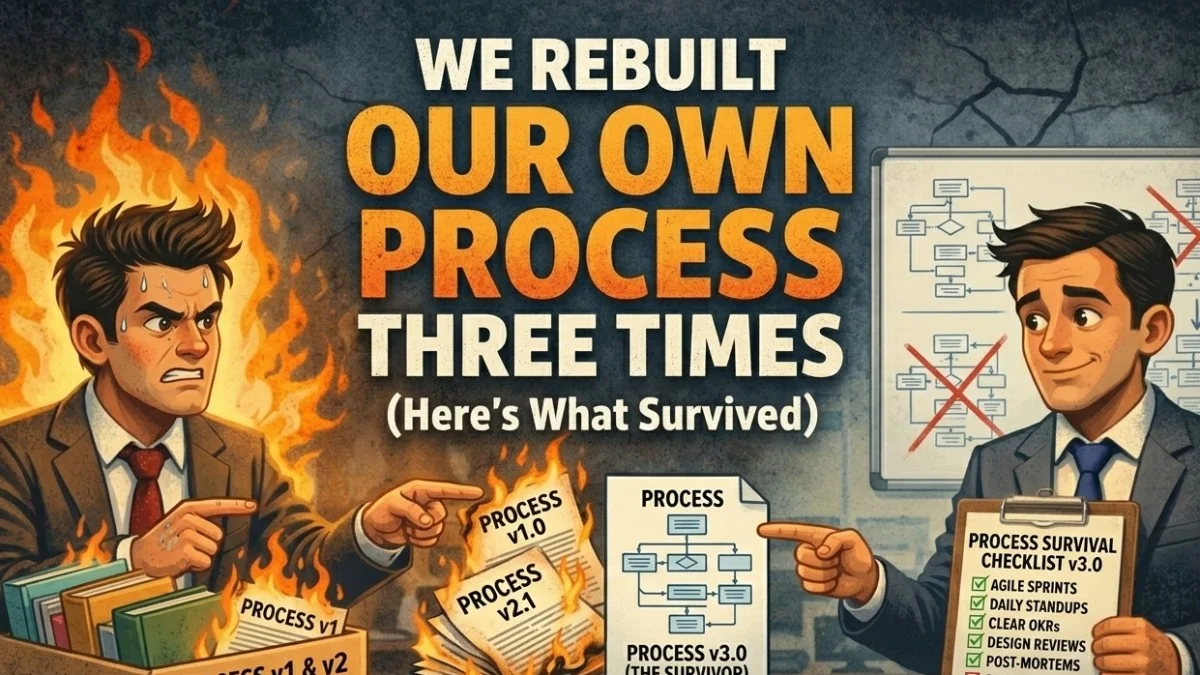
Our first delivery process was held together with duct tape and optimism.
No standardized phases. No structured scope documents. No client portal. Just a shared Google Drive and a lot of Slack messages.
It worked until we hit 5 concurrent projects. Then it collapsed spectacularly.
Version 1 failures:
→ Clients never knew project status without asking → Scope was "whatever we discussed in that one call" → No consistent code quality standards → Handoffs between team members were guesswork → We were reinventing the wheel on every project
So we overcorrected. V2 was a 47-page process manual with templates for everything.
We documented our documentation process. We had pre-meeting meetings. We built elaborate status reports that took 3 hours to compile.
Nobody followed it. Too heavy. Too slow. Clients felt buried in paperwork.
One client told us: "I hired you to build software, not to manage a bureaucracy."
Fair point.
Version 3 took 8 months to develop. We analyzed every project from the previous 18 months. What actually prevented problems? What was just theater?
What survived to become ScopeForged's core:
→ 5-phase structured delivery (Assess → Design → Build → Test → Launch) → 19-category technical audits (automated + manual reviews) → Client portal for real-time visibility (no status meetings) → Fixed-scope milestones with clear acceptance criteria → 48-hour onboarding that surfaces misalignment immediately → Paid project assessments before we touch code
What we killed:
→ Weekly status reports (replaced by portal) → Elaborate documentation templates (replaced by working prototypes) → Rigid timelines (replaced by milestone-based delivery) → Hourly billing (replaced by fixed milestone pricing)
The lesson: Your process should remove friction, not create it. If your team is working around your process, your process is the problem.
We're probably still on V3.7 at this point. It'll never be perfect. But it's finally something we actually use.
What's one process improvement that actually stuck at your company?
#ProcessImprovement #AgencyLife #SoftwareDevelopment #ProductDelivery #ContinuousImprovement
→ scopeforged.com
Philip Rehberger Founder, ScopeForged scopeforged.com