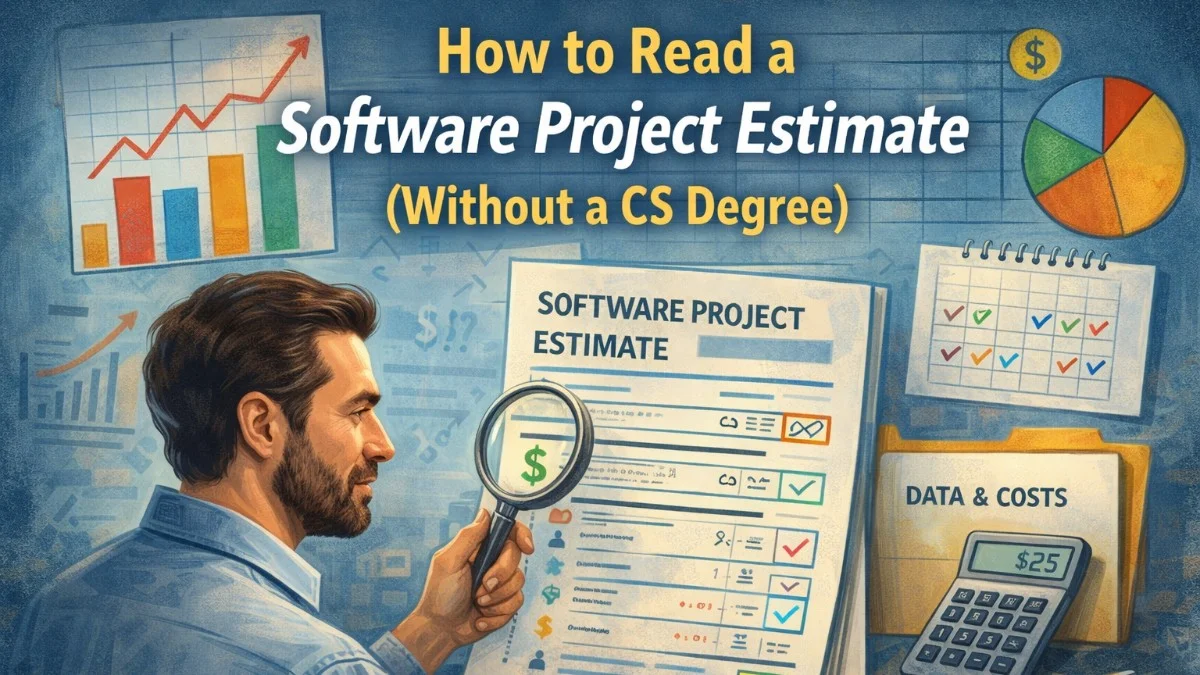
You just got a software estimate. It's 12 pages of line items, hour ranges, and jargon.
You're not technical. How do you know if it's good?
Here's how to read a software estimate without a CS degree:
1. What "hours" really mean
When you see "40-60 hours," that's not wall-clock time. It's focused development time. Meetings, email, and context-switching aren't included. So 40 dev hours might span 2 weeks of calendar time.
2. Why ranges exist
Ranges aren't vagueness, they're honesty. Software has unknowns. A range says, "We're 80% sure it's 40 hours, but if X happens, it could be 60." No range? They're guessing.
3. What contingency buffers are
Good estimates include a 10-20% buffer for unknowns. That's not padding, it's risk management. If they don't have a buffer, the first surprise will blow the budget.
4. Why some "simple" tasks are expensive
"Just add a login button" sounds easy. But it touches authentication, database permissions, security, UI state, error handling, and testing. Simple for users ≠ simple to build.
5. What to worry about
→ Missing items. No mention of testing? Deployment? Documentation? Those still need to happen, they're just not priced.
→ Vague deliverables. "User dashboard" isn't a spec. What's in the dashboard? What can users do?
→ No assumptions. Every estimate assumes something (API access, design files, server access). If assumptions aren't listed, miscommunication is coming.
6. What NOT to worry about
→ Line-item precision. "Is this task really 8 hours or 7?" doesn't matter. The total is what matters.
→ Hourly rate comparisons. A $200/hr developer who works fast is cheaper than a $100/hr developer who works slow.
→ The estimate not matching your budget. If your budget is $20K and the estimate is $40K, the estimate isn't wrong, your budget is.
Here's what we do at ScopeForged:
Every estimate includes:
→ Milestone-based breakdown (not just hours) → Explicit assumptions → Risk items flagged separately → What's included vs. what's not → Fixed-scope pricing (no hourly surprises)
The best estimates teach you something about your project.
If you finish reading an estimate and don't understand your project better, the estimate failed.
What's the most confusing thing you've seen in a software estimate?
#SoftwareDevelopment #ProjectEstimates #TechBuying #DigitalTransformation #StartupAdvice
→ scopeforged.com
Philip Rehberger Founder, ScopeForged scopeforged.com