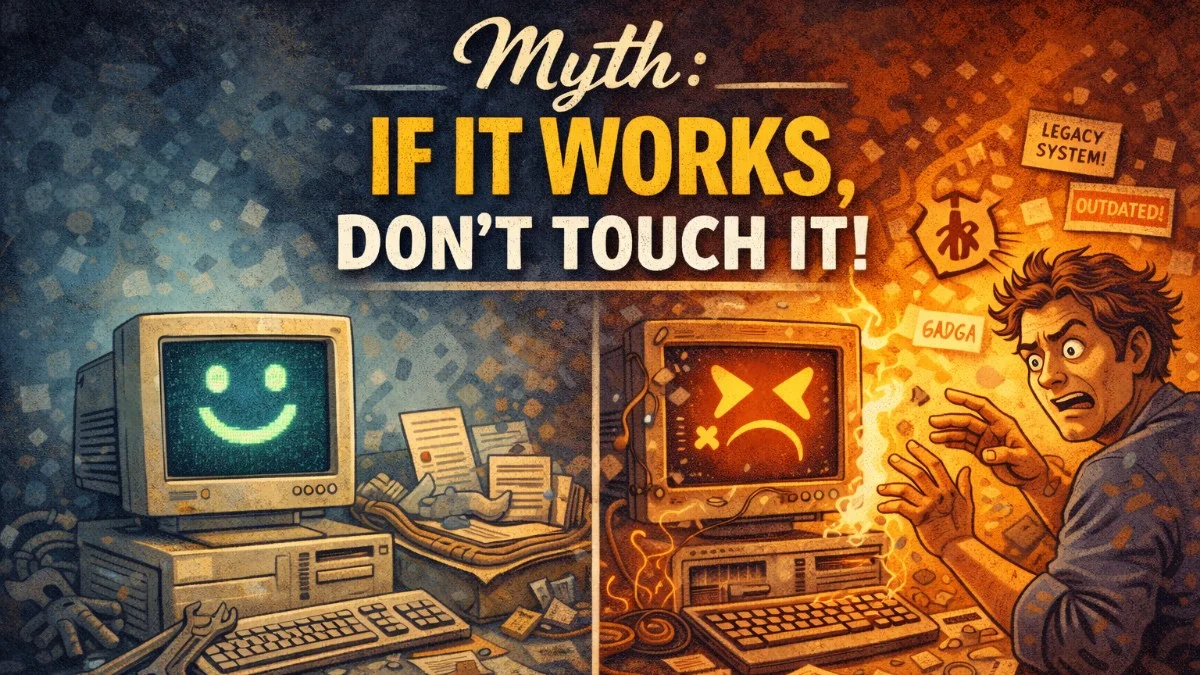
"If it works, don't touch it."
This is the most dangerous myth in software.
Here's why.
Software that "works" but isn't maintained is a ticking time bomb.
I've seen it explode:
→ Dependencies go out of date, exposing critical security vulnerabilities → The server OS stops getting patches, becoming a target for exploits → The SSL certificate expires, taking the entire site offline → The database fills up, causing the application to crash → Third-party APIs change, breaking integrations overnight
"Working" and "healthy" are not the same thing.
A car that starts isn't the same as a car that's been serviced.
Eventually, the oil runs out.
The brakes wear down.
The battery dies.
Software is the same.
Here's what happens when you don't maintain software:
→ Security vulnerabilities accumulate — every unpatched dependency is a potential exploit → Technical debt compounds — small issues become architectural problems → Knowledge is lost — the person who built it leaves, and no one knows how it works → Recovery gets more expensive — fixing 3 years of neglect costs 10x more than ongoing maintenance → The system becomes fragile — any change risks breaking everything
I've seen companies ignore maintenance for years.
Then one day:
→ A security breach exposes customer data → A critical integration breaks and can't be fixed quickly → A server crashes and no one knows how to restart it → A competitor ships a feature they can't match because their codebase is too brittle
Now they're scrambling.
The cost of emergency fixes is 10x the cost of proactive maintenance.
And that's just the financial cost.
The reputational cost? Even higher.
Healthy software requires:
→ Regular dependency updates — security patches, compatibility fixes → Monitoring and alerting — know when something breaks before your customers do → Documentation — so future you (or your team) can understand what's happening → Refactoring — cleaning up technical debt before it becomes unmanageable → Testing — so you can change things confidently without breaking everything
"If it works, don't touch it" is how you end up with a system that doesn't work.
And when it fails, it fails catastrophically.
Maintenance isn't optional.
It's the difference between software that lasts and software that collapses.
What's your approach to maintaining legacy systems?
#SoftwareMaintenance #TechnicalDebt #SoftwareDevelopment #TechLeadership #DevOps
→ scopeforged.com
Philip Rehberger Founder, ScopeForged scopeforged.com