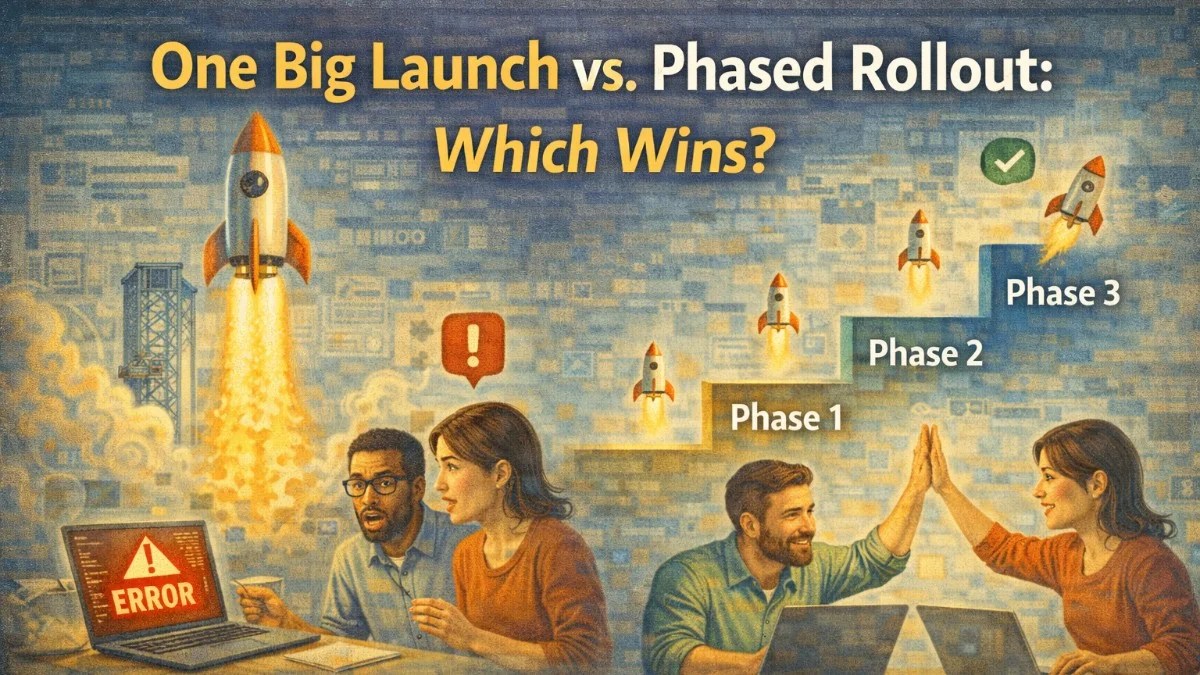
Everyone wants the big launch moment. Most regret it.
Here's why:
The Big Bang Launch
→ Build everything → Test everything → Launch everything at once → Hope it works
The appeal: One dramatic moment. Big announcement. All features live.
The Reality
→ Higher risk: One bug can take down the entire system → Longer timeline: Can't ship until everything is perfect → No real feedback: You're guessing what users actually need → Harder to fix: Live users while you're debugging critical issues → More expensive: Building features users won't use
I've seen 12-month "big bang" projects launch with 30% of features unused after 90 days.
The Phased Rollout
→ Ship the core first → Get real user feedback → Add features based on actual usage → Iterate between phases
Phase 1: Core functionality (20% of features, 80% of value) Phase 2: High-demand additions (based on user requests) Phase 3: Nice-to-haves (if they're still needed)
Why Phased Wins
→ Lower risk: Problems are contained to one phase → Faster time-to-value: Users get something in 4 months, not 12 → Real feedback: Build what users actually need, not what you think they need → Easier to pivot: Course-correct between phases → Better budget control: Stop when you have enough
The Surprise
The features you think are critical often aren't.
The features users actually need often surprise you.
Example: We built a client portal. Planned feature list: 47 items.
→ Phase 1: Shipped 12 features → User feedback: "Love it. Can we get feature X?" → Feature X wasn't on the original roadmap → Phase 2: Built feature X + 5 requested features → Phase 3: Never happened. They didn't need anything else.
Final delivery: 18 features instead of 47. Users happier. Budget under.
When Big Bang Makes Sense
→ Replacing an existing system (can't run both) → High integration dependencies (everything needs everything) → Regulatory requirements (must have all features to comply) → Small scope (4-8 weeks total)
Everything else? Go phased.
How to Structure Phases
→ Phase 1: Minimum Viable Product (can users accomplish the core goal?) → Phase 2: Most-requested additions (based on real usage) → Phase 3: Optimization and scale
Gap between phases: 2-4 weeks for feedback collection.
The ROI Argument
Big bang: $200K, 12 months, go-live December 15th Phased: $120K, Phase 1 live in 4 months, Phase 2 in 8 months
The phased approach generates revenue 8 months earlier while costing 40% less.
What's your experience? Big bang or phased?
#ProductDevelopment #AgileMethodology #SoftwareStrategy #ProductManagement #TechLeadership
→ scopeforged.com
Philip Rehberger Founder, ScopeForged scopeforged.com