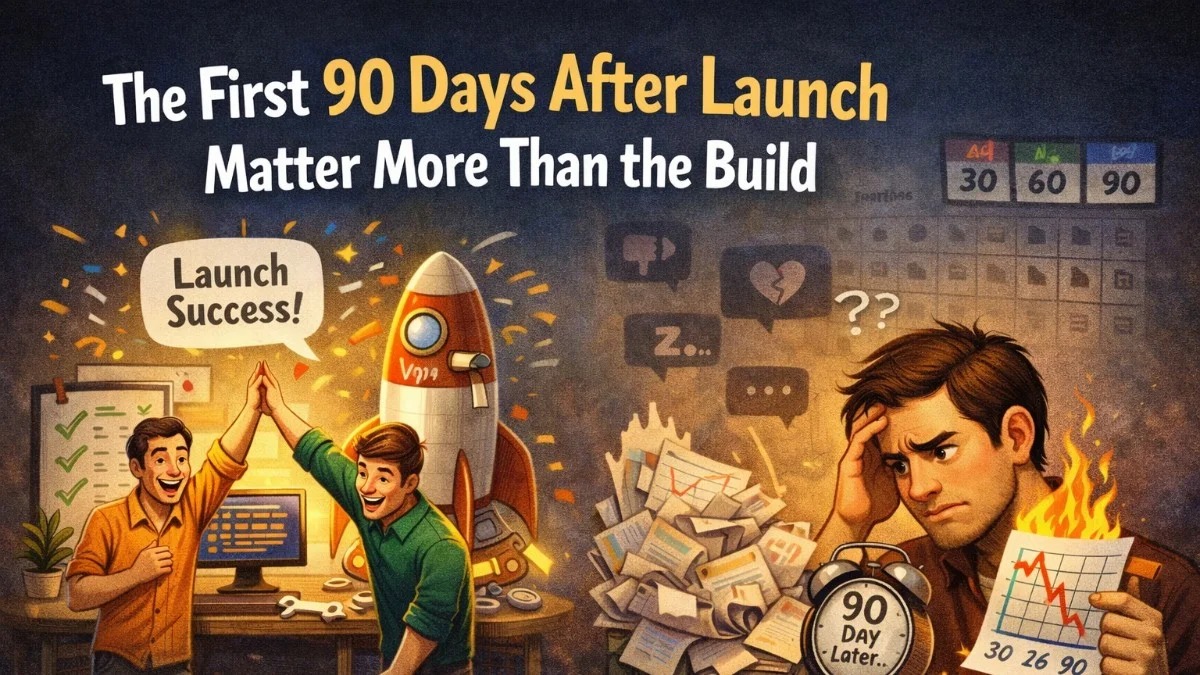
You spent 6 months building.
The first 90 days after launch will teach you more than the entire build.
Real users reveal everything discovery missed.
No matter how thorough your planning, real usage patterns are unpredictable:
→ Users find bugs you never imagined → Load patterns differ wildly from projections → Features you thought were critical get ignored → Features you thought were minor become the most-used
This is normal. This is expected. This is where the real work begins.
The 90-day plan that works.
Here's how we structure the critical post-launch period:
Daily (Days 1-30): → Monitor error logs and performance metrics → Track user behavior analytics → Collect and categorize feedback → Fix critical bugs within 24 hours
Weekly (Days 1-90): → User feedback analysis sessions → Feature usage review → Performance optimization planning → Prioritization of iteration backlog
Bi-weekly (Days 1-90): → Iteration sprints for quick improvements → A/B testing of critical flows → User interviews with power users → Stakeholder alignment on direction
This is where good software becomes great.
The companies that nail this phase? Their software keeps getting better.
The companies that treat launch as "done"? Their software becomes legacy within a year.
What most teams get wrong.
They think launch is the finish line. It's actually the starting line.
They move the team to the next project. The software never reaches its potential.
They ignore user feedback because "we already built what they asked for."
The teams that get it right?
They budget for 90 days of post-launch iteration. They keep the core team engaged. They treat user feedback as product intelligence, not complaints.
And their software shows it.
Your software's potential is realized in the first 90 days, not the first 90 commits.
How do you structure your post-launch phase?
#ProductDevelopment #SoftwareLaunch #ProductManagement #UserExperience #AgileMethodology
→ scopeforged.com
Philip Rehberger Founder, ScopeForged scopeforged.com