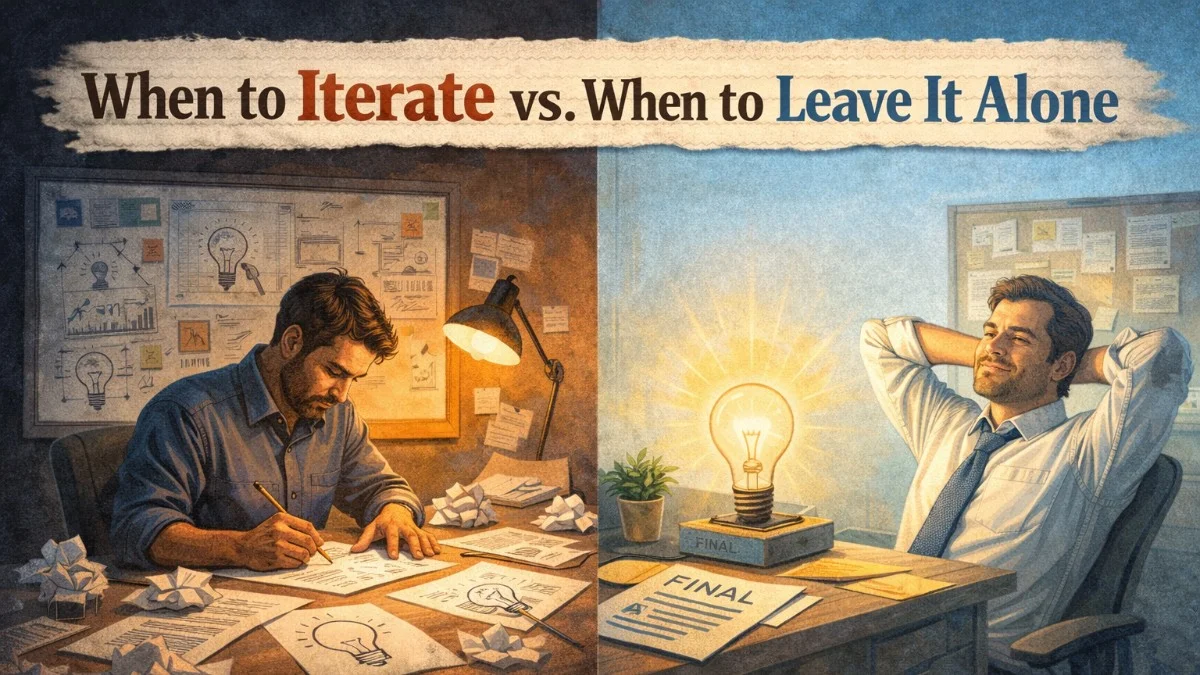
Not everything needs improvement.
The hardest skill in software: knowing when to stop.
I've seen teams iterate themselves into worse products. Changing things that worked. Fixing things that weren't broken.
Here's when to iterate:
→ Users complain about specific pain points — Consistent feedback about the same issue → Analytics show drop-off in critical flows — Data reveals friction → Business requirements change — What worked 6 months ago doesn't fit today → Performance degrades — Speed or reliability issues appear
These are signals. Not hunches. Not opinions. Signals.
Here's when to leave it alone:
→ It works reliably — No bugs, no performance issues, no user complaints → Users aren't asking for changes — Silence is often satisfaction → Improvement would be cosmetic — Visual tweaks that don't affect usability → The change is just change — Different, not better
The iteration trap.
Product teams feel pressure to show progress. So they iterate on things that don't need iteration.
They redesign interfaces that users already understand. They add features to workflows that already work. They change things because "we should be doing something."
This creates three problems:
- Regression risk — Working features break during "improvements"
- User confusion — People have to relearn interfaces
- Wasted resources — Time spent on cosmetic changes instead of real problems
The "good enough" principle.
Some parts of your software should be boring. Stable. Reliable. Good enough.
Your login flow? Perfect it once, then leave it alone.
Your settings page? Simple and functional beats fancy.
Your core workflow? If users can complete it efficiently, don't mess with it.
Where to focus your iteration energy.
The 80/20 rule applies: 80% of user value comes from 20% of features.
Iterate on that 20%. Maintain the 80%.
→ Iterate on high-traffic flows with measurable friction → Iterate on features central to your value proposition → Iterate when data shows a clear problem
Leave alone everything else.
The decision framework.
Before iterating, ask:
- What problem does this solve?
- How do we know this problem exists?
- What's the user impact if we do nothing?
- What's the risk if the change makes things worse?
If you can't answer these clearly, leave it alone.
Maturity is knowing when to stop.
Junior teams iterate constantly. Senior teams iterate strategically.
The best products aren't the ones that change the most. They're the ones that change when it matters.
How do you decide what to iterate on?
#ProductManagement #SoftwareDevelopment #ProductStrategy #Engineering #ProductDesign
→ scopeforged.com
Philip Rehberger Founder, ScopeForged scopeforged.com