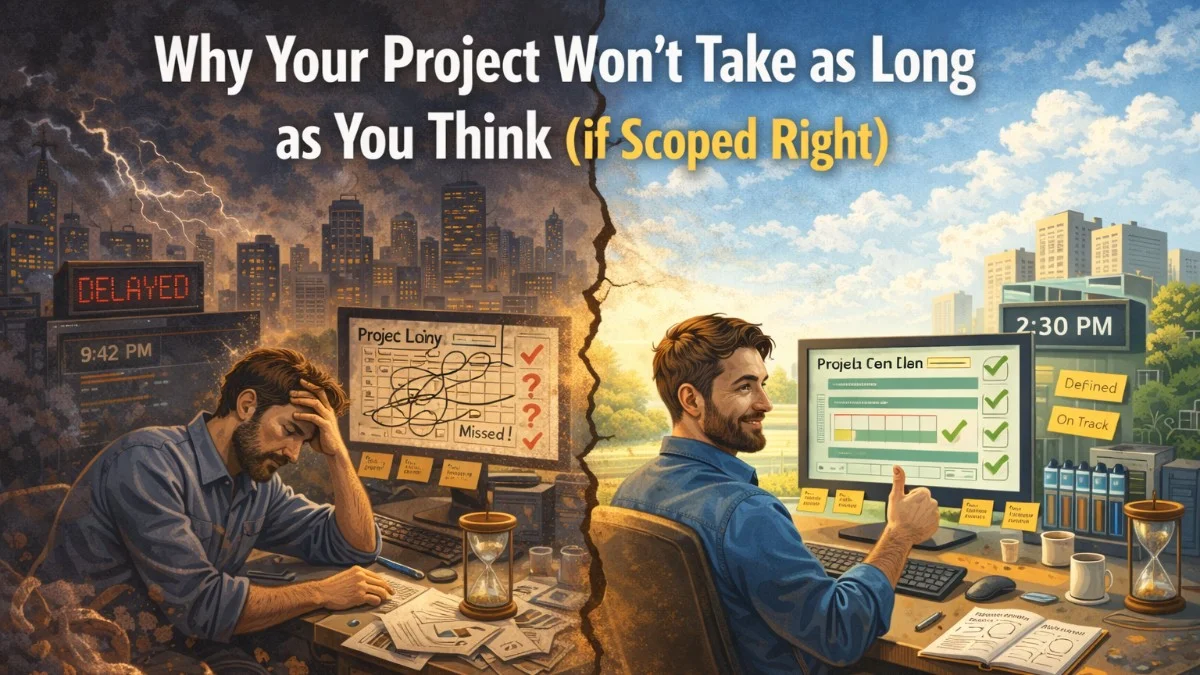
A prospect told me his last project took 14 months.
He showed me the original scope doc. I read it. Then I asked: "How much of this actually shipped?"
"Maybe 60%. The rest got cut or changed."
That's not a 14-month project. That's 7 months of confusion wrapped in 7 months of real work.
Here's the truth most agencies won't tell you:
Projects don't take forever because they're big. They take forever because they're poorly scoped.
What poor scoping looks like:
→ Feature list with no prioritization → No user research validating the features → Vague success metrics ("users will love it") → No milestone gates to validate direction → Scope creep disguised as "collaboration"
You end up building features you don't need, redesigning flows that were fine, and debating decisions that should have been made in discovery.
What structured scoping looks like:
→ 2-week paid discovery phase before any code is written → Feature prioritization based on validated user needs → Clear milestone deliverables with decision gates → Scope locked per milestone (changes happen between gates, not during) → Weekly progress visible in the client portal
The result?
That same prospect's "14-month rebuild" became a 4-month MVP at ScopeForged. We cut 40% of the features in discovery (he admitted they were guesses). We delivered in milestones so he could test with real users after each phase.
He launched in month 5. Not month 14.
The compression came from clarity, not speed.
We didn't work faster. We worked on the right things.
At ScopeForged, our 5-phase delivery process (Discover → Build → Audit → Launch → Iterate) is designed to eliminate waste.
Every feature is justified. Every milestone is validated. Every decision is documented.
No confusion. No drift. No "14-month death marches."
Have you ever had a project that felt endless? What made it drag on?
#ProjectManagement #SoftwareDevelopment #ScopeCreep #AgileDelivery #TechConsulting
→ scopeforged.com
Philip Rehberger Founder, ScopeForged scopeforged.com