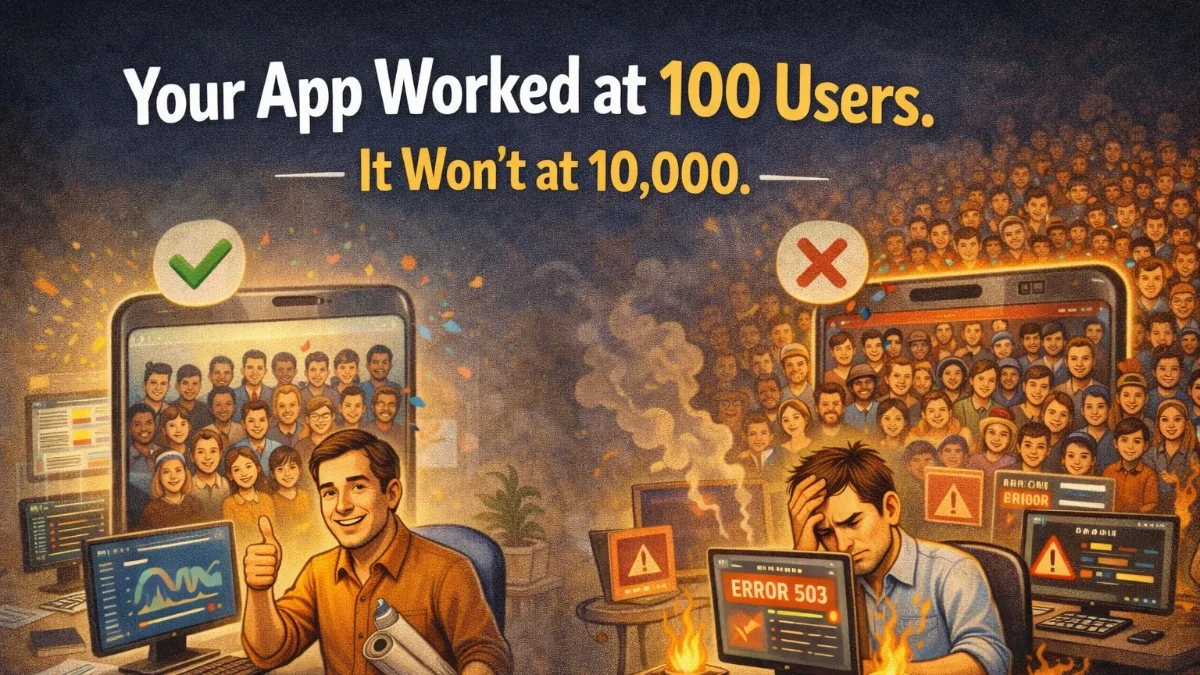
Your app launches. 100 users. Everything's fast. Six months later, 10,000 users. Everything's broken.
Here's what breaks at scale:
→ Database queries that were fine with 1,000 rows take 30 seconds with 100,000 rows → Single-server architecture hits CPU and memory limits → File uploads clog the server because there's no CDN → Session management falls apart without Redis or database sessions → No caching strategy means every page load hits the database for the same data
I've seen this pattern dozens of times. The app worked perfectly in development. It worked fine at launch. But nobody asked: "What happens when this 10x in size?"
The warning signs:
→ Page loads that were 200ms are now 3 seconds → Background jobs are backing up in the queue → Server CPU is constantly maxed out → Users reporting timeouts and errors → Your monitoring alerts are firing constantly
What to do about each:
Slow queries: Add indexes, optimize joins, use eager loading instead of N+1 queries.
Server limits: Move to load-balanced architecture, add caching layers, offload static assets to a CDN.
File storage: Switch to S3 or similar, serve through CloudFront.
Session issues: Move to Redis or database-backed sessions.
Cache nothing: Implement Redis caching for database queries, API responses, and computed values.
The hard truth: performance doesn't scale linearly. Code that's "fast enough" at 100 users can be completely unusable at 10,000.
The best time to think about scaling is during discovery. The second best time is now.
When did you first realize your app had scaling problems? What broke first?
#SoftwareDevelopment #WebDevelopment #Scaling #TechDebt #PerformanceOptimization #StartupLessons
→ scopeforged.com
Philip Rehberger Founder, ScopeForged scopeforged.com