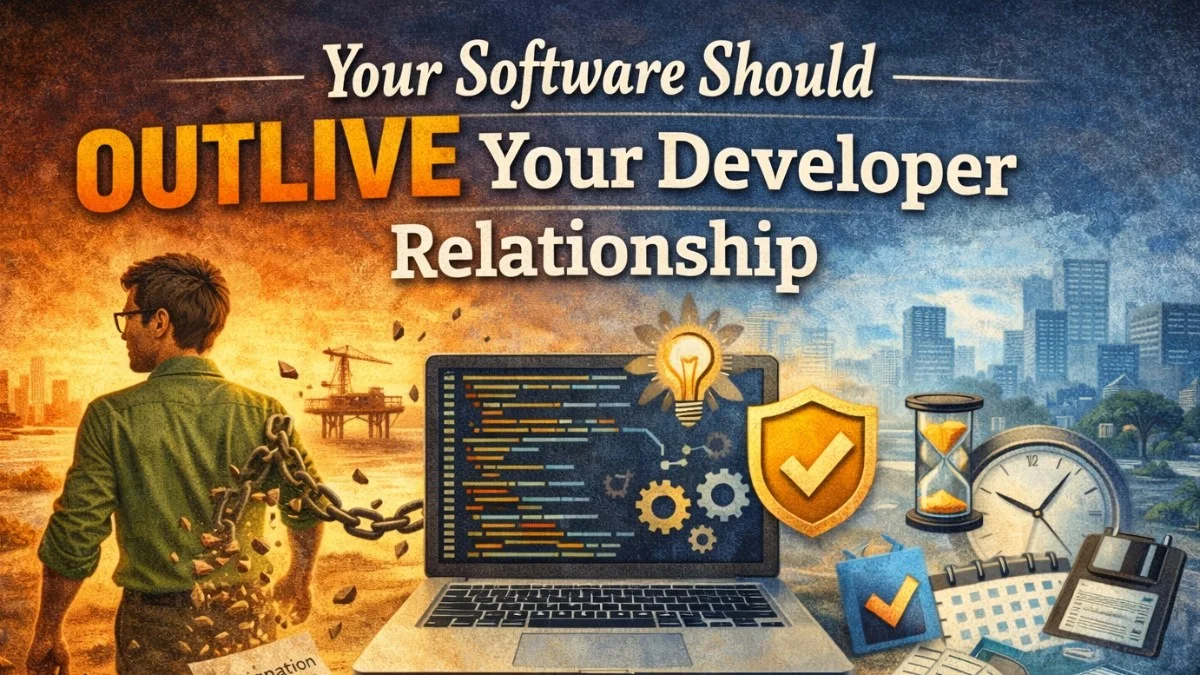
Relationships end.
Agencies close. Teams change. Freelancers move on. Priorities shift.
Your software should survive all of it.
If your software only works as long as the original developer is around, you don't own software.
You rent it.
The Reality of Software Relationships
Most custom software projects assume a long-term relationship.
You'll keep working with the same agency. The same developer. The same team.
But that's not reality:
→ Agencies shut down or pivot → Developers leave for new opportunities → Budgets get cut and projects get paused → Priorities shift and relationships end
Your software needs to outlive the relationship.
Because most relationships don't last as long as the software does.
How to Build Software That Survives
Software that outlives the relationship has these qualities:
1. Open-Source Technologies
No proprietary frameworks. No licensing traps.
Use technologies that any competent developer can work with:
→ Laravel, Django, Rails (not a custom framework) → React, Vue, Svelte (not a proprietary UI library) → PostgreSQL, MySQL (not a vendor-specific database)
2. Complete Documentation
Not "TODO: add docs later."
Comprehensive, written-for-someone-who-wasn't-there documentation:
→ What the system does and why → How to set up a local environment → How to deploy to production → How to troubleshoot common issues → How to add new features
3. Automated Deployments
No manual SSH sessions. No "call me when you need to deploy."
One command. Anyone can do it.
4. Monitoring That Any Admin Can Understand
Not a dashboard that only the developer understands.
Clear, actionable monitoring:
→ Is the site up? → Are there errors? → Is performance degrading?
5. A Codebase That's Approachable
A competent developer should be able to pick it up in a week.
Not six months. Not "only the original developer understands this."
One week to be productive.
What Code Ownership Really Means
Code ownership isn't just "the code is in your repo."
It's the ability to continue without the original developer.
→ Can you deploy without them? → Can you troubleshoot without them? → Can you hire someone else to maintain it? → Can you hand it off to an internal team?
If the answer is "no," you don't own it.
You're dependent on it.
ScopeForged's Philosophy
We build every project with the assumption that we won't be the long-term maintainer.
Maybe we will. Maybe the relationship lasts years.
But maybe it doesn't.
And when it ends—whether planned or unplanned—the software should keep working.
That's what code ownership really means.
Not just access to the repo. But the ability to move forward without us.
The Survival Test
If your developer disappeared tomorrow:
→ Could you deploy a change? → Could you troubleshoot an issue? → Could you hire someone else to maintain it? → Could you understand what the software does and why?
If not, you're at risk.
Your software should outlive the relationship.
Build it that way from day one.
Does your software pass the survival test?
#SoftwareDevelopment #CodeOwnership #TechnologyStrategy #SoftwareConsulting #BusinessContinuity
→ scopeforged.com
Philip Rehberger Founder, ScopeForged scopeforged.com