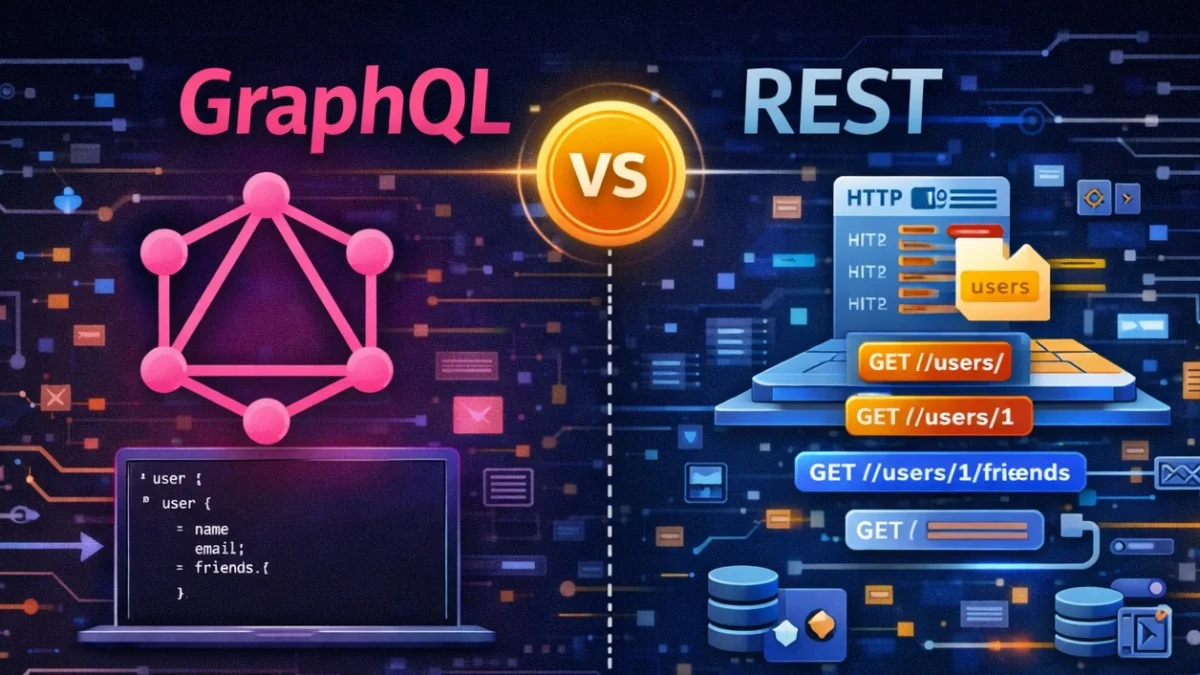
Choosing between GraphQL and REST is one of the most debated API design decisions. Both approaches have passionate advocates and legitimate use cases. This guide cuts through the hype to help you make an informed decision based on your specific requirements.
Understanding the Fundamentals
REST (Representational State Transfer)
REST uses standard HTTP methods to operate on resources identified by URLs. Each resource has a dedicated endpoint, and the HTTP verb indicates the action you want to perform. This resource-oriented design maps naturally to database entities.
GET    /api/users/123          # Get user
POST   /api/users              # Create user
PUT    /api/users/123          # Update user
DELETE /api/users/123          # Delete user
GET    /api/users/123/posts    # Get user's posts
Each endpoint returns a fixed structure defined by the server. The client accepts whatever fields the server provides, which simplifies the server implementation but can lead to inefficiencies.
GraphQL
GraphQL takes a fundamentally different approach. Instead of multiple endpoints, it provides a single endpoint where clients specify exactly what data they need through a query language. You describe what you want, and the server returns precisely that.
query {
  user(id: 123) {
    name
    email
    posts(first: 5) {
      title
      publishedAt
    }
  }
}
The client controls the shape of the response. You ask for specific fields, and that's exactly what you receive. This client-driven approach shifts complexity from the client to the server.
Key Differences
Data Fetching
One of the most significant differences is how you gather related data. With REST, building a profile page often requires multiple sequential or parallel requests to different endpoints.
REST: Multiple Round Trips
// Fetch user profile page data
const user = await fetch('/api/users/123');
const posts = await fetch('/api/users/123/posts');
const followers = await fetch('/api/users/123/followers');
// 3 requests, potentially over-fetching data
Each request adds latency, especially on mobile networks where round-trip times are higher. You're also receiving complete objects even when you only need a few fields from each.
GraphQL: Single Request
GraphQL consolidates these into a single network round trip where you specify exactly what you need. The server handles the complexity of gathering data from multiple sources.
query UserProfile {
  user(id: 123) {
    name
    avatar
    posts(first: 5) { title }
    followersCount
  }
}
// 1 request, exact data needed
Over-fetching and Under-fetching
REST endpoints typically return complete resource representations, which leads to a common problem: you either get too much data or not enough.
REST Challenge:
Consider what happens when you only need a user's name and avatar for a comment card, but the endpoint returns everything.
// GET /api/users/123 returns everything
{
  "id": 123,
  "name": "John",
  "email": "john@example.com",
  "avatar": "...",
  "bio": "...",
  "createdAt": "...",
  "settings": {...},
  "permissions": {...}
  // 20 more fields you don't need
}
When you only need the user's name and avatar for a comment card, you're still downloading their entire profile. On mobile devices with limited bandwidth, this waste adds up quickly.
GraphQL Solution:
With GraphQL, you request exactly the fields you need, nothing more. The response size matches your requirements.
# Request only what you need
query {
  user(id: 123) {
    name
    avatar
  }
}
API Evolution
APIs need to change over time. REST and GraphQL handle this evolution differently, each with trade-offs.
REST Versioning:
REST APIs typically version their endpoints, forcing clients to migrate when breaking changes occur. This creates maintenance overhead on both sides.
/api/v1/users
/api/v2/users  # Breaking changes
This means maintaining multiple versions simultaneously or coordinating rollouts across all clients. Old versions can linger for years if you have external consumers.
GraphQL Evolution:
GraphQL allows gradual evolution by deprecating fields while adding new ones. Old clients continue working while new clients adopt the improved fields.
type User {
  name: String
  fullName: String  # Add new field
  email: String @deprecated(reason: "Use emailAddress")
  emailAddress: String
}
The deprecation directive warns developers without breaking existing queries. You can track which deprecated fields are still being used and plan their removal accordingly.
When to Choose REST
Simple CRUD Applications
When your application primarily involves creating, reading, updating, and deleting resources without complex relationships, REST's simplicity becomes an advantage. The mental model is straightforward.
Products, Orders, Users, Comments
↓
Standard CRUD operations
↓
REST is natural fit
The one-to-one mapping between resources and endpoints makes the API intuitive and easy to understand. Developers familiar with HTTP immediately grasp the patterns.
Caching Requirements
REST leverages HTTP caching naturally because each resource has its own URL. Caches at every level understand how to store and invalidate REST responses without custom logic.
GET /api/products/123
Cache-Control: max-age=3600

# CDNs, browsers, proxies all understand this
GraphQL POST requests don't cache by default because each request body can be different. While you can implement caching solutions with persisted queries or GET requests, it requires additional work and infrastructure.
Public APIs
REST's simplicity benefits external consumers who may not be familiar with your system. The learning curve is minimal for developers who know HTTP.
- Well-understood conventions
- Easy to document with OpenAPI
- Works with any HTTP client
- No special libraries required
Anyone who knows HTTP can use your REST API. GraphQL requires clients to learn a new query language and often needs specialized client libraries for optimal use.
File Uploads
REST handles multipart uploads straightforwardly using standard HTTP semantics that every web framework supports out of the box. There's no special consideration needed.
// Laravel REST endpoint
public function store(Request $request)
{
    $file = $request->file('document');
    // Process upload
}
GraphQL requires workarounds for file uploads, such as the multipart request specification or separate REST endpoints for uploads. Neither is as clean as native HTTP multipart support.
When to Choose GraphQL
Complex, Nested Data
When your UI needs deeply nested related data, GraphQL's ability to fetch everything in one request becomes compelling. Consider a dashboard that needs user info, notifications, projects, and recent activity, all connected in various ways.
query Dashboard {
  currentUser {
    notifications(unread: true) {
      message
      createdAt
    }
    projects {
      name
      recentActivity(first: 3) {
        description
        user { name }
      }
    }
  }
}
With REST, you'd need multiple requests or custom aggregate endpoints that couple your backend to specific frontend needs. GraphQL handles this complexity elegantly.
Mobile Applications
Mobile apps benefit significantly from GraphQL's efficiency due to network constraints and the cost of battery-draining radio usage.
- Reduced bandwidth (request only needed fields)
- Fewer round trips (single request)
- Offline-first with client caching
When every byte counts and network latency is unpredictable, having fine-grained control over data fetching makes a real difference in user experience.
Rapidly Evolving Frontends
When UI requirements change frequently, GraphQL lets frontend developers move faster without waiting for backend changes. If a field already exists in the schema, they can start using it immediately without coordination.
# Frontend team adds field without backend changes
query {
  product(id: 1) {
    name
    price
    # New requirement: show stock status
    stockStatus  # Just add it if it exists
  }
}
Multiple Clients with Different Needs
When you're building a single API that serves mobile apps, web apps, and admin dashboards, each client can request exactly what it needs from the same endpoint.
# Mobile: minimal data
query { user { name, avatar } }

# Web: full profile
query { user { name, avatar, bio, posts, followers } }

# Admin: everything
query { user { ...allFields, internalNotes, auditLog } }
No need for different API versions or conditional response logic. Each client self-serves its specific requirements.
Implementation Considerations
REST Implementation (Laravel)
Laravel makes REST APIs straightforward with resource controllers and API resources. The framework's conventions map naturally to REST's resource-oriented design.
// Clean, simple controllers
class UserController extends Controller
{
    public function show(User $user)
    {
        return new UserResource($user->load(['posts', 'profile']));
    }
}

// API Resources control output
class UserResource extends JsonResource
{
    public function toArray($request): array
    {
        return [
            'id' => $this->id,
            'name' => $this->name,
            'email' => $this->when($request->user()?->isAdmin(), $this->email),
            'posts' => PostResource::collection($this->whenLoaded('posts')),
        ];
    }
}
The when and whenLoaded methods provide conditional field inclusion, giving you some flexibility similar to GraphQL's field selection. This approach keeps controllers thin while centralizing transformation logic.
GraphQL Implementation (Laravel + Lighthouse)
Lighthouse is the most popular GraphQL library for Laravel. It uses a schema-first approach where you define your types in SDL (Schema Definition Language), then implement resolvers for custom logic.
// Schema definition
type Query {
    user(id: ID! @eq): User @find
    users: [User!]! @paginate
}

type User {
    id: ID!
    name: String!
    email: String! @canAccess(ability: "viewEmail")
    posts: [Post!]! @hasMany
}

// Resolver for complex logic
class UserResolver
{
    public function posts(User $user, array $args)
    {
        return $user->posts()
            ->published()
            ->orderBy('created_at', 'desc')
            ->limit($args['first'] ?? 10)
            ->get();
    }
}
Lighthouse's directives like @find, @hasMany, and @canAccess eliminate boilerplate code for common patterns. The schema becomes a living contract between frontend and backend.
Performance Considerations
REST Performance
The N+1 query problem affects both REST and GraphQL, but the solutions differ. In REST, you typically eager load relationships at the controller level based on what you know the response needs.
// N+1 problem requires explicit eager loading
public function index()
{
    // Bad: N+1 queries
    return User::all();

    // Good: Eager load
    return User::with(['posts', 'profile'])->get();
}
GraphQL Performance
GraphQL uses the DataLoader pattern to batch database queries. When multiple user objects request their posts, DataLoader collects all the user IDs and makes a single query instead of one per user.
// N+1 solved with DataLoader pattern
class PostLoader
{
    public function load(array $userIds): array
    {
        return Post::whereIn('user_id', $userIds)
            ->get()
            ->groupBy('user_id')
            ->toArray();
    }
}
This batching happens automatically if you use libraries like Lighthouse that implement DataLoader. You get efficient queries without explicit eager loading at every resolver.
Query Complexity
GraphQL's flexibility creates a potential security risk. Clients can craft deeply nested queries that overwhelm your server by requesting exponentially growing data sets.
# Potentially expensive query
query {
  users(first: 1000) {
    posts(first: 100) {
      comments(first: 100) {
        author { posts { comments { ... } } }
      }
    }
  }
}
You must implement query complexity analysis to prevent abuse. Lighthouse makes this straightforward with configuration.
// Lighthouse configuration
'security' => [
    'max_query_complexity' => 100,
    'max_query_depth' => 10,
],
These limits reject queries that exceed complexity thresholds before execution begins, protecting your server from malicious or accidental denial-of-service queries.
Hybrid Approaches
You don't have to choose exclusively. Many successful applications use both REST and GraphQL where each makes sense, taking advantage of both approaches.
/api/v1/*           → REST for simple CRUD
/graphql            → GraphQL for complex queries
/api/v1/upload      → REST for file uploads
/api/v1/webhooks    → REST for external integrations
This pragmatic approach lets you leverage each technology's strengths without fighting against its weaknesses. Start with what you know, then add the other where it provides clear value.
Decision Framework
| Factor | Choose REST | Choose GraphQL |
|---|---|---|
| Data relationships | Simple, flat | Complex, nested |
| Client diversity | Single client type | Multiple platforms |
| Caching needs | Critical | Less important |
| Team experience | REST familiar | GraphQL familiar |
| API consumers | External/public | Internal/controlled |
| Change frequency | Stable requirements | Rapidly evolving |
Conclusion
Neither GraphQL nor REST is universally better. REST excels for simple, cacheable APIs with external consumers. GraphQL shines for complex data requirements with controlled clients. Consider your specific needs: data complexity, caching requirements, client diversity, and team expertise. Many successful systems use both, choosing the right tool for each use case.